FTC Disclosure: Vice City Locals is reader-supported. When you buy through links on this site, we may earn an affiliate commission at no extra cost to you. All opinions are our own.
Best Mid-Range TV for GTA 6 (Under $800)
Last Updated: September 2026
You don’t need to spend $2,000 on an OLED to get a phenomenal GTA 6 experience. In 2026, the mid-range TV market is absolutely stacked — you can get 4K, 144Hz, Mini-LED, VRR, Dolby Vision, and full HDMI 2.1 for under $800. That’s flagship territory from just two years ago, available at half the price.
This guide is for the smart shopper: the player who wants maximum GTA 6 performance per dollar, without paying an OLED premium. When Vice City drops on November 19, 2026, these are the TVs that deliver the best bang for your buck.
What Does $500–$800 Get You in 2026?
Two years ago, spending $800 on a TV meant compromising on something — usually refresh rate, HDR format, or HDMI 2.1 ports. Not anymore. Here’s what’s now standard in the mid-range tier:
| Feature | Standard in 2026 Mid-Range | Why It Matters for GTA 6 |
|---|---|---|
| Resolution | 4K (3840 × 2160) | Console standard |
| Refresh Rate | 144Hz native | Smooth motion + lower latency |
| Panel Type | Mini-LED with QLED | Deep blacks + vibrant colors |
| HDMI 2.1 | At least 1–2 ports (often all 4) | 4K@120Hz from PS5/Xbox |
| VRR | FreeSync + HDMI Forum VRR | Tear-free gaming on both consoles |
| HDR | Dolby Vision + HDR10+ | Dynamic HDR for Vice City’s neon |
| Input Lag | Under 10ms in Game Mode | Responsive controls |
That last point is key: Mini-LED with QLED is now the mid-range standard. This panel technology combines thousands of local dimming zones (for deep blacks) with quantum dot color enhancement (for vibrant, saturated colors). It’s not OLED — but it’s 80–90% of the way there, at one-third the price.
Mid-Range vs. Premium: What’s the Difference?
| Feature | Mid-Range ($500–$800) | Premium ($1,500+) |
|---|---|---|
| Panel | Mini-LED QLED | OLED (QD-OLED or WOLED) |
| Contrast | Excellent (finite zones) | Infinite (per-pixel) |
| Peak Brightness | 800–1,000 nits | 1,000–2,000+ nits |
| Black Uniformity | Good (some blooming) | Perfect (no blooming) |
| Viewing Angles | Narrower than OLED | Wide |
| Refresh Rate | 144Hz | 120–144Hz |
| HDMI 2.1 | ✅ | ✅ |
| VRR | ✅ | ✅ |
| HDR Format | Dolby Vision + HDR10+ | Varies (Dolby Vision or HDR10+) |
| Input Lag | Under 10ms | Under 6ms |
The core gaming features are identical. What you lose at mid-range is picture quality — specifically OLED’s perfect blacks and infinite contrast. For many gamers, that’s a trade worth making to save $1,000+.
Top Mid-Range TVs for GTA 6
Comparison Table
| TV | Panel | Refresh Rate | Dolby Vision | Price | Value Score |
|---|---|---|---|---|---|
| TCL QM6K (65″) | Mini-LED QLED | 144Hz | ✅ | ~$650 | ⭐⭐⭐⭐⭐ |
| Hisense U8QG (65″) | Mini-LED | 144Hz | ✅ | ~$900* | ⭐⭐⭐⭐ |
| Samsung QN90F (65″) | Neo QLED Mini-LED | 120Hz | ❌ | ~$1,600* | ⭐⭐⭐⭐ |
*Prices fluctuate; QN90F and U8QG can sometimes be found near $800 on sale.
1. TCL QM6K — The Mid-Range King

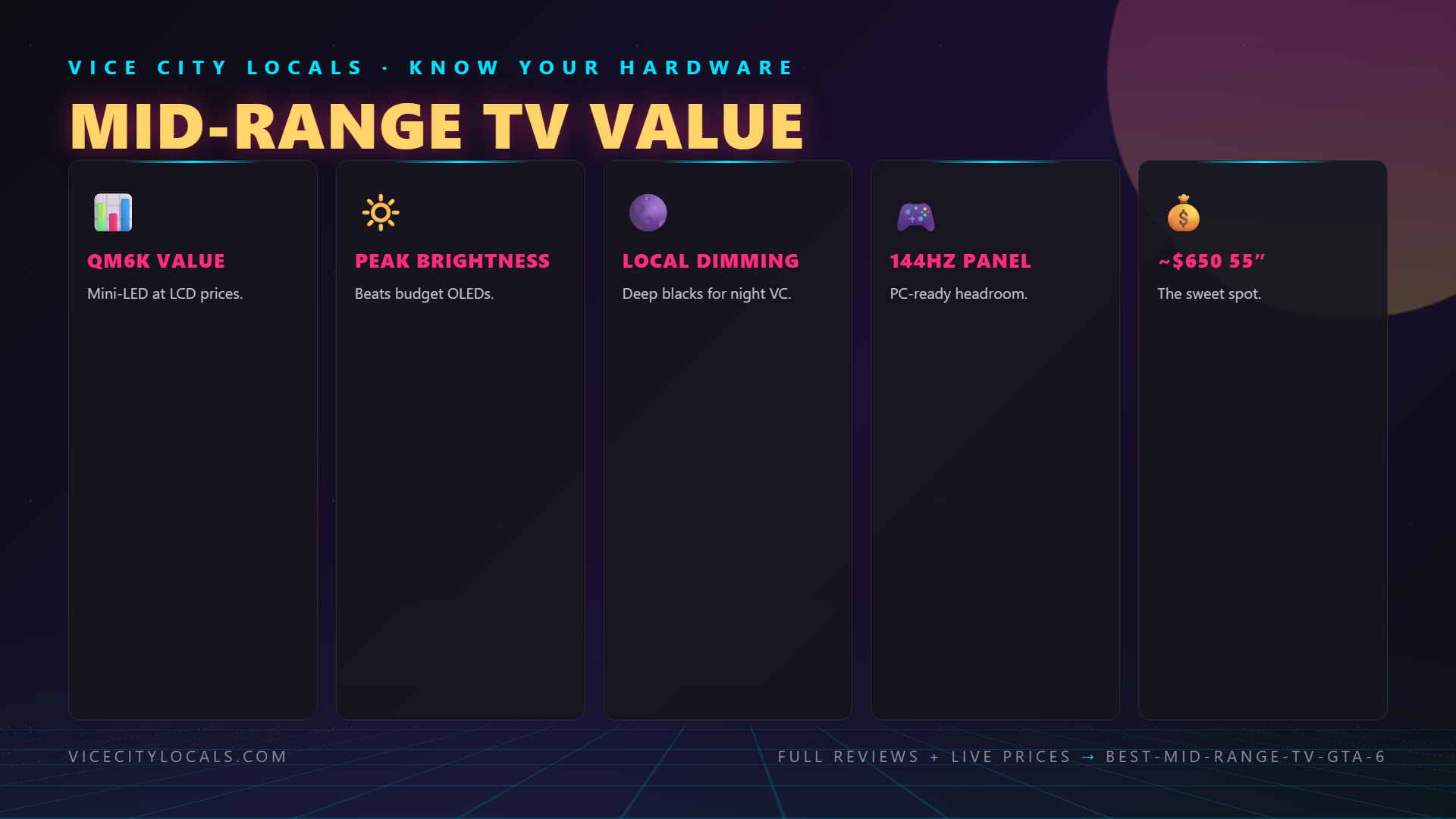
The TCL QM6K isn’t just the best mid-range TV for GTA 6 — it’s one of the best values in TV history. For approximately $500 (55″) or $650 (65″), you get a Mini-LED QLED panel running at 144Hz with full HDMI 2.1, both major VRR formats, and Dolby Vision. This TV genuinely competes with displays costing two to three times as much.
Why it’s the star of this guide:
144Hz Mini-LED Panel The QM6K’s 144Hz refresh rate is remarkable at this price point. Most TVs at $500–$800 still ship with 120Hz panels. The extra 24Hz gives you lower latency, smoother motion, and future-proofing if you ever connect a gaming PC.
Full HDMI 2.1 Bandwidth All gaming ports support full 48Gbps HDMI 2.1 bandwidth. This means 4K@120Hz with HDR from PS5 or Xbox Series X — no compromises, no throttled bandwidth.
Dolby Vision + HDR10+ The QM6K supports both Dolby Vision (PS5’s HDR format) and HDR10+ (Samsung’s HDR format). This dual support is rare even on premium TVs, and it means you’re covered regardless of which console you play on.
Quantum Dot Color TCL’s QLED quantum dot layer produces vibrant, saturated colors that make Vice City’s neon palette pop. This is where the QM6K punches above its price class — color reproduction rivals TVs costing twice as much.
Game Accelerator Mode TCL’s Game Accelerator reduces input lag to under 10ms and can push the panel to 240Hz at lower resolutions (for PC gamers). For GTA 6 at 4K@120Hz, you’re looking at input lag around 6–9ms — excellent.
Trade-offs: – Blooming/blooming artifacts — bright objects on dark backgrounds can show slight halos (common to all Mini-LEDs, more noticeable than on premium models) – Viewing angles — narrower than OLED; the picture degrades if you sit off-center – HDR processing — good but not as refined as LG or Samsung’s premium processing
At $500–650, the TCL QM6K is an absurd value. If you’re shopping for GTA 6 on a budget, this is where your search should start and probably end.
2. Hisense U8QG — Step Up in Brightness and Zones
The Hisense U8QG sits just above the TCL QM6K in price (~$900 for 65″, but regularly dips below $800 on sale). It offers more dimming zones, higher peak brightness, and better HDR processing — a meaningful step up in picture quality for about $150–250 more.
Why consider it over the TCL QM6K:
More Dimming Zones = Better Blacks The U8QG features a higher zone count than the QM6K, meaning deeper blacks and less blooming around bright objects. For GTA 6’s night scenes — Vice City’s neon lights against dark streets — this translates to noticeably better contrast.
Higher Peak Brightness The U8QG hits approximately 900–1,000 nits peak brightness in HDR, compared to the QM6K’s ~800 nits. This matters for daytime Vice City scenes: sun-drenched beaches, glaring ocean reflections, and bright explosions all look more impactful.
144Hz with Game Mode Pro Like the QM6K, the U8QG offers 144Hz and full HDMI 2.1. Hisense’s Game Mode Pro adds VRR support (both FreeSync and HDMI Forum VRR), low input lag, and ALLM.
Dolby Vision Support Full Dolby Vision gaming support at 4K@120Hz — great for PS5 players.
Trade-offs: – More expensive — at ~$900 MSRP, it pushes the upper boundary of “mid-range” (though sales bring it closer to $700–800) – UI/OS — Hisense’s VIDAA smart TV OS isn’t as polished as Google TV (TCL) or Tizen (Samsung) – Still Mini-LED — can’t match OLED’s infinite contrast
If you can find the U8QG under $800 on sale, it’s an excellent step up from the QM6K — especially for HDR brightness.
3. Samsung QN90F — Premium Mini-LED (On Sale)
The Samsung QN90F is normally a $1,600+ premium TV, but it regularly goes on sale for $1,000–$1,200 — and occasionally dips close to $800 during major sales events (Black Friday, Prime Day, etc.). If you can catch it at the right price, it’s the best Mini-LED TV you can buy.
Why it’s worth hunting for a deal:
Neo QLED Technology Samsung’s Neo QLED uses a quantum Mini-LED backlight with thousands of precision-controlled dimming zones. It’s the brightest, most refined Mini-LED implementation on the market. For GTA 6’s HDR highlights, nothing beats it.
OTS (Object Tracking Sound) The QN90F features Samsung’s Object Tracking Sound, which uses built-in speakers to create a virtual surround sound experience that follows on-screen action. It’s not a replacement for a soundbar, but it’s the best built-in TV audio you’ll find.
Best-in-Class Motion Processing Samsung’s motion processing is industry-leading. Even at 60fps, the QN90F delivers smoother, cleaner motion than any Mini-LED competitor. For GTA 6’s fast driving sequences, this is noticeable.
Trade-offs: – No Dolby Vision — Samsung uses HDR10+ instead, which means PS5 players lose Dolby Vision gaming – 120Hz, not 144Hz — the QN90F’s panel runs at 120Hz, not 144Hz like the QM6K or U8QG – Price — even on sale, it’s typically the most expensive option in this guide
The QN90F is the best Mini-LED TV available — but at its typical sale price of $1,000+, it’s competing with OLED territory. Only buy it if you specifically want Mini-LED’s brightness advantage in a bright room.
Mid-Range Buying Guide: Maximizing Value
The $650 Sweet Spot
If there’s one price point that defines the mid-range value champion in 2026, it’s $650 — the price of a TCL QM6K 65″. At this price, you get:
- 65″ 4K 144Hz Mini-LED QLED panel
- Dolby Vision + HDR10+
- Full HDMI 2.1 with 4K@120Hz
- FreeSync + HDMI Forum VRR
- Under 10ms input lag
- Quantum dot color enhancement
Compare that to a $1,800 Samsung S90F OLED 65″: you pay an extra $1,150 for OLED’s perfect blacks, wider viewing angles, and slightly lower input lag. The core gaming experience — 4K, 120Hz, VRR, HDR, HDMI 2.1 — is identical.
What to Prioritize in Mid-Range
| Priority | What to Look For | TV That Delivers |
|---|---|---|
| Gaming Performance | 144Hz, VRR, HDMI 2.1, low input lag | TCL QM6K |
| HDR Quality | Dolby Vision, high brightness, many dimming zones | Hisense U8QG |
| Brightness | 1,000+ nits for bright rooms | Samsung QN90F (on sale) |
| Best All-Around Value | All of the above for the lowest price | TCL QM6K |
What to Avoid in Mid-Range
- Fake “120Hz” TVs — some budget brands use “Motion Rate 120” or “Effective 120Hz” marketing. This means the panel is actually 60Hz with motion interpolation. Look for native or true 120Hz in the specs.
- Single HDMI 2.1 port — some mid-range TVs only offer one HDMI 2.1 port. If you have a console + soundbar + streaming device, you’ll run out of bandwidth-capable ports quickly.
- Edge-lit LED — avoid edge-lit LED panels. They have terrible black uniformity. You want full-array local dimming (FALD) or Mini-LED.
FAQ
Q: Is a mid-range TV really good enough for GTA 6?
A: Absolutely. The core gaming features that matter most for GTA 6 — 4K, 120Hz (or 144Hz), HDMI 2.1, VRR, and HDR — are all available on mid-range Mini-LED TVs. You’re giving up OLED’s perfect blacks, but you’re saving $1,000+ and getting 80–90% of the visual experience.
Q: Should I buy the TCL QM6K or wait for Black Friday?
A: The QM6K is already an exceptional value at $500–650. Black Friday might save you $50–100, but GTA 6 launches November 19, 2026 — right around Black Friday. If you want your TV set up and dialed in before launch, buy it a month or two early.
Q: Is Mini-LED that much worse than OLED?
A: “Worse” is subjective. Mini-LED is actually brighter than OLED, making it better for HDR highlights and bright rooms. OLED has perfect blacks and infinite contrast, which is better for dark-room viewing. For gaming, both are excellent. The main visible difference is blooming on Mini-LED (halos around bright objects on dark backgrounds) vs. perfect uniformity on OLED.
Q: Can I get Dolby Vision under $800?
A: Yes! Both the TCL QM6K and Hisense U8QG support Dolby Vision at 4K@120Hz. This is a PS5 advantage — if you’re on Xbox, Dolby Vision doesn’t matter for gaming (Xbox uses HDR10+).
Q: What size should I buy for under $800?
A: 65″ is the sweet spot. Both the TCL QM6K 65″ (~$650) and Hisense U8QG 65″ (~$900 on sale) deliver the best value at this size. Going up to 75″ usually pushes you over $800 in mid-range territory.
Final Thoughts
The mid-range TV market in 2026 is the best it’s ever been. You can get a genuinely excellent GTA 6 gaming experience for $500–800 — no compromises on the core features that matter. Here are our final picks:
- Best overall value: TCL QM6K — Check Price (55″) (The undisputed value champion — 144Hz Mini-LED QLED for $500)
- Best mid-range HDR: Hisense U8QG (More brightness and dimming zones for $150–250 more)
- Best premium deal: Samsung QN90F (Hunt for it on sale — the best Mini-LED if you can find it near $800)
If you’re spending $500–800 on a GTA 6 TV, the TCL QM6K should be your default choice. It hits every spec that matters, supports both major HDR formats, runs at 144Hz, and costs less than a new PS5 Pro. That’s an unbeatable value proposition.
Don’t overthink it. Buy the QM6K, dial in Game Mode, enable VRR, and get ready for Vice City. November 19, 2026 — it’s going to be a beautiful launch.
Related GTA 6 Guides
- Best TV for GTA 6 — Buying Guide
- Best Budget TV (Under $500)
- Best 120Hz TV — VRR & HDMI 2.1
- Best Budget Controllers for GTA 6
Want GTA 6 news the second it drops? Join the Locals — our free newsletter. No spam, unsubscribe anytime.