
GTA 6 NEWS · TECHNICAL ANALYSIS
“Most Visually Advanced Game to Date”: The Tech Experts’ Full Verdict on GTA 6
When Rockstar dropped 26 minutes of GTA 6 gameplay, the internet did what the internet does: argued about graphics, counted pixels, and compared the game unfavorably to a 2013 console generation. Now the people who measure these things for a living have weighed in — and their verdict makes the frame-rate debate look very small indeed.
Digital Foundry, the technical analysis outlet whose frame-rate breakdowns are treated as gospel, has published its full Extended Look deep dive — and it doesn’t just praise GTA 6. It calls the showcase “perhaps the most impressive showcase we’ve ever seen in real-time rendering.” GameSpot’s headline on the report gets straight to the point: tech experts call GTA 6 the most visually advanced game to date — which is exactly why it’s stuck at 30fps.
That’s not a contradiction. It’s the whole story of what Rockstar is actually doing with the RAGE 9 engine — and it’s bigger than a frame-rate number.
What Happened: Digital Foundry’s Full Breakdown
The analysis — written by William Judd with DF founders Richard Leadbetter and Oliver Mackenzie, with a full DF Direct Special video to follow — picked the Extended Look apart frame by frame. The quotes landing hardest: Leadbetter describes the scale of the achievement as singular across the entire console generation, “gaming’s equivalent to the Apollo space programme,” while Mackenzie goes further, calling it the most impressive example of real-time game rendering he’s ever seen.
For a console generation that’s already delivered Cyberpunk 2077’s path-traced Night City and Red Dead Redemption 2’s decade-defining detail, that’s a staggering claim. Here’s what earned it.

The Hair Alone Is a Technical Milestone
Character rendering is where DF says GTA 6 clears every other game on the market. The standout: hair simulation with generational improvements across straight, wavy, and curly hair — with proper light transport and secondary motion. Lucia’s hair behaves realistically in cutscenes and gameplay alike, with base-to-tip motion, delayed follow-through, and convincing snap-back that you almost never see in real-time hair.
Skin shading gets the same treatment: specular highlights that track realistically, sweat and make-up that look true to life, and bodies in hot, humid spaces that look genuinely slick — this is Florida, after all. DF notes this level of fidelity is rare even in pre-rendered cutscenes, and GTA 6 delivers it in gameplay.
Ray Tracing Isn’t a Checkbox — It’s the Foundation
Under the hood, Rockstar has doubled down on the shift to ray tracing that began with GTA 5 Enhanced Edition. Two systems stand out in the analysis:
Ray-traced reflections everywhere. Specular reflections are deployed across opaque and transparent surfaces, with skinned meshes — actual characters — visible in reflections even where screen-space data wouldn’t suffice. Certain household mirrors still use planar reflections, a classic technique Rockstar keeps because it looks better for that specific case. Where an older technique wins, it stays in the toolbox.
Ray-traced global illumination. Interiors and exteriors are lit with indirect light bounces that respect occlusion, color bleeding, and complex geometry — DF calls RT “arguably indispensable” here, because baked lighting would be near-impossible to pull off in a world this dense and dynamic. Subtle effects like colored light transmission through transparent objects and characters feeding light back into nearby surfaces are visible in the footage.
The trade-off is where the 30fps story connects. The PS5 build appears to render at 1440p internally — DF found no strong evidence of modern temporal upscalers — meaning the image is a relatively straightforward spatial upscale to 4K, with some softness and shimmer on fine details. RT noise and smeared reflections under camera motion are visible if you look for them. If you want the full frame-rate analysis, we covered DF’s performance verdict separately — including why even a gaming PC might struggle to hit 60.
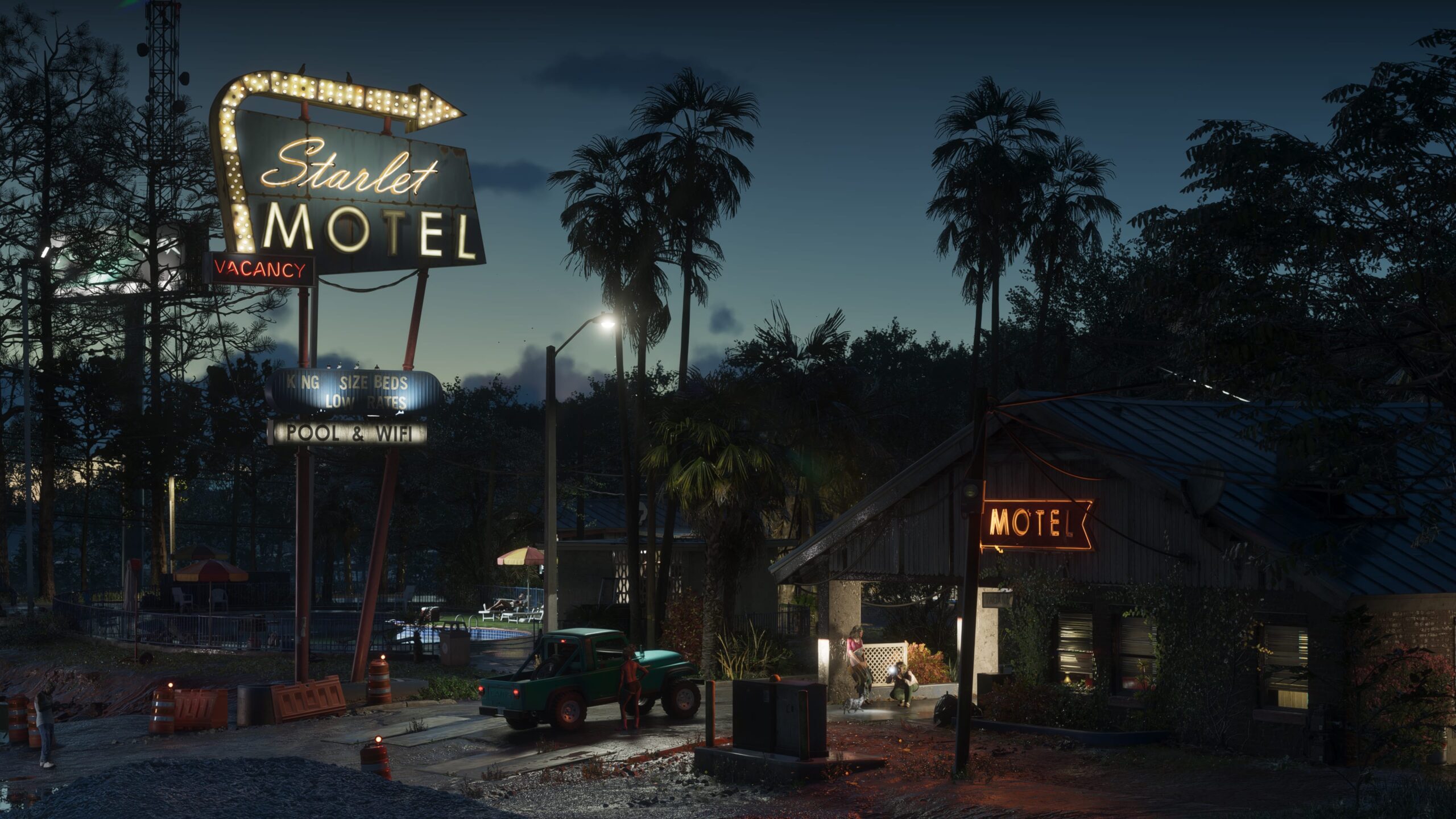
The Simulation Is the Real Flex
Rendering is only half the story. DF’s analysis highlights simulation scale as a key differentiator: large crowds in clubs and on beaches, numerous vehicles, and a suggestion of higher per-character agency than any prior open-world game. Rockstar appears to be targeting believable pathfinding, varied reactions, and persistence as NPCs move in and out of the player’s vicinity — plus rigid-body physics, destructible props, and rich environmental detail.
DF adds appropriate scientific caution: the trailer’s curated nature means the true extent of emergent behavior — how crowds react when chaos breaks out, how far persistence reaches — remains unproven until November 19. But the building blocks are unlike anything shipped before.
What This Means for GTA 6
Here’s the framing that matters. Rockstar didn’t fail to hit 60fps — they chose density over frame rate, tuning rendering, simulation, and presentation around a fixed 30fps on all platforms, with trade-offs landing in image quality and animation smoothness rather than systemic scale. The result, per DF, is “an unprecedented level of density, material quality and world coherence.”
There’s even hope for the frame-rate crowd: per reports from those speaking to Rockstar, higher frame-rate modes will be considered for post-launch updates — echoing what Rockstar’s Rob Nelson hinted about needing to “consult the technical team.” We break down the full 30fps situation in our earlier coverage of Rockstar’s frame-rate confirmation.
For PS5 Pro owners, the Extended Look was captured on a base PS5, so the Pro’s stronger GPU and PSSR upscaling should translate into better image quality and higher-quality RT effects — though DF notes we won’t know precisely where the Pro build lands until footage exists. And on PC? Higher resolutions via DLSS and longer draw distances, yes — but DF warns the CPU demands of a world this complex could make 60fps “genuinely challenging” even on high-end hardware.
If you’re still on the fence about which machine to experience it on, our PS5 vs Xbox buying guide for GTA 6 has the current pricing picture. And for everything Rockstar packed into those 26 minutes beyond the tech specs, don’t miss the small GTA 6 details that stole the show.
The Weak Points DF Flagged — Because Nothing Is Perfect
A verdict this glowing doesn’t come without fine print, and DF’s report is refreshingly honest about the compromises. Three stand out.
The Rage engine judder. Even within the solid 30fps delivery, DF identified a persistent animation and camera pacing issue that ranks as a long-standing quirk of Rockstar’s Rage engine. Character animation and camera pans can exhibit uneven motion — some frames show larger position jumps than others, producing a subtle but pervasive stutter that can make the game feel lower than its actual frame rate. Given its history across Rockstar projects, DF suspects it won’t be resolved for launch.
Image softness. That 1440p internal resolution with no dynamic resolution scaling and no modern upscaler means the 4K output carries visible geometric aliasing and shimmer on fine details — the price of spending every GPU cycle on lighting, simulation, and density instead.
Unproven emergence. The footage is curated. How crowds actually react when chaos breaks out, how far NPC persistence really reaches — those questions can only be answered by playing the shipped game on November 19, not by watching a trailer.
None of that dims the headline, though. When the harshest criticisms of the most visually advanced game ever made are “slightly soft image” and “subtle animation judder,” the bar Rockstar has cleared becomes very, very clear.
Want GTA 6 news the second it drops? Join the Locals — free newsletter, no spam.
Related reading: Digital Foundry’s 60fps verdict · Rockstar confirms 30 FPS · The small details that stole the show